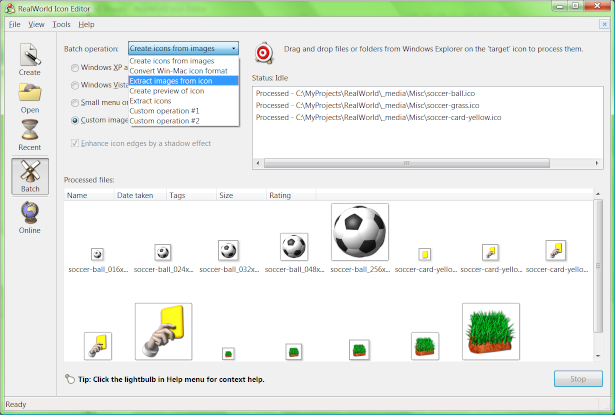
Yellow color is automatically detected as background.
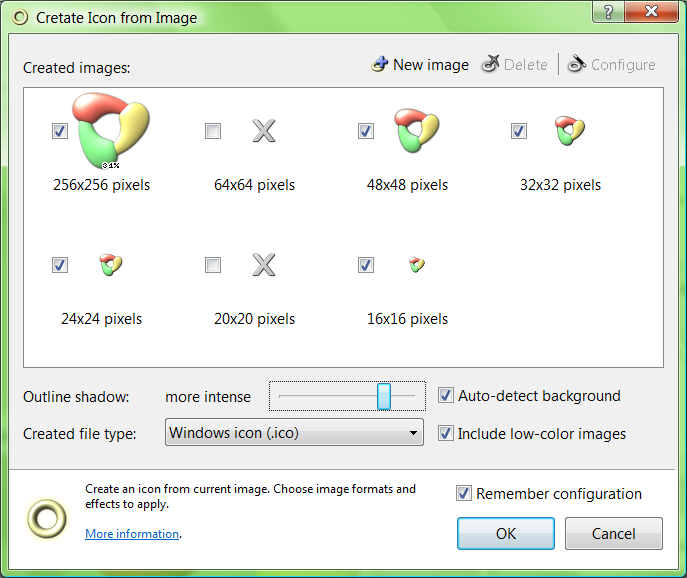
|  |  Space required by shadow is computed and reserved for each generated image.
|
 Configure generated image sizes and color-depths and additional effects to apply.
| |  Editing non-standard 40x20 pixels icon.
|
 Use checkmark.ico from included icon library to make icons itended to configure given feature in target application.
| |  Select an executable file and get icons inside it.
|
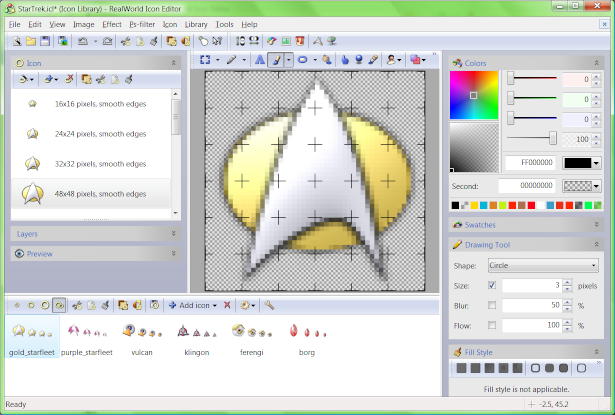
 Version 2005.2 features a new default layout for icon editing. This layout makes use of an improved image selection window that can display multiple icon images simultaneously.
| |  Application runs on Windows Vista Beta 1. Installation must be performed using this workaround.
|
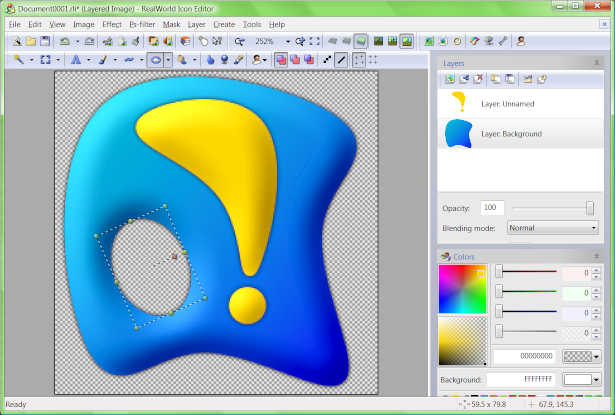
 Different blending modes used by the ellipses.
| |  Draw curves with selected width and color by specifying points that the curve must go through.
|
 Color and alpha gradient fill.
| |  Resize and move rectangular area.
|
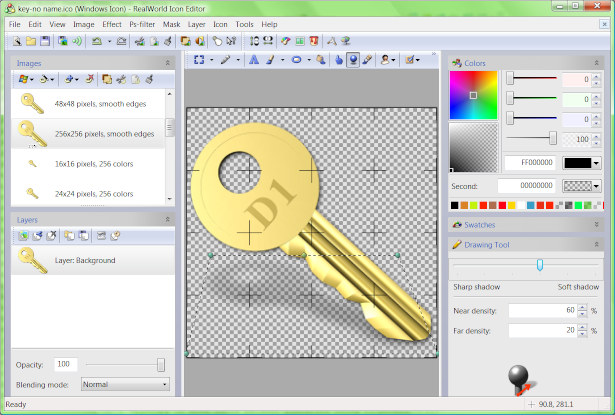
 Image opens by default in "view mode".
| |  "Edit as raster image" button switches to edit mode.
|
 Hue of each pixel was replaced by defined value using the "Colorize" image filter
| |  "Export Image" command lets you export any image and set encoding options.
|
 Built-in basic 3D shapes with different materials and textures.
| |  Torus and tank basic shapes were added in version 2005.2
|
 Surface of revolution (yellow), extrusion surface (orange) and generic NURBS surface (red).
| |  Create simple object parts directly from triangles.
|
 Importing 3D objects from 3D Studio .3ds files.
| |  Set positions and rotations of finger segments using control points.
|
 Subcomponents are put together to form one top level component for each tool.
| |  Various aspect of the model are controlled by four top-level parameters.
|
 Set and save lights, camera and renderer properties. Instant scene preview.
| |  Slightly modified scene demonstrates use of normal bump-maps in raytracing rendering device. See the bumps on the ground and on the rock.
|
 A simple display 3D model created in integrated Unicorn3D editor.
| |  6 rouned boxes + 1 box + one surface of revolution...
|
 The computer case 3D model is even simpler than the display.
| |  This could not get any easier.
|
 Setting camera, lights, and rendering device configuration.
| |  A complete icon after one click - get used to it.
|
 Rendered image again. This time with different 3D model and updated camera.
| |  Vieweing the 16x16 pixel image generated directly from 3D model.
|
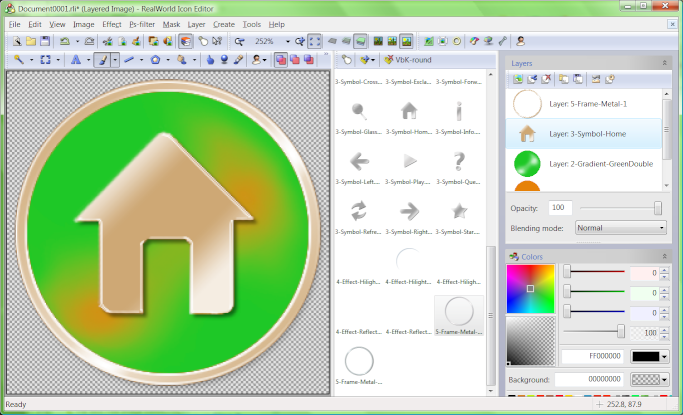
 Working with Vista icon in special edition of RealWorld Icon Editor 2005.2.1. Large image in Vista icons are stored using PNG compression.
| |  An icon can be saved without compression (Win XP), with large images compressed (default Vista format) or with all images compressed for minimum file size.
|
 Create new Unicorn3D document by selecting the 'New Unicorn3D document' prototype and clicking the 'Create' button.
| |  Components are added to Unicorn3D documents by clicking 'Insert component' toolbar button or 'Document' menu command.
|
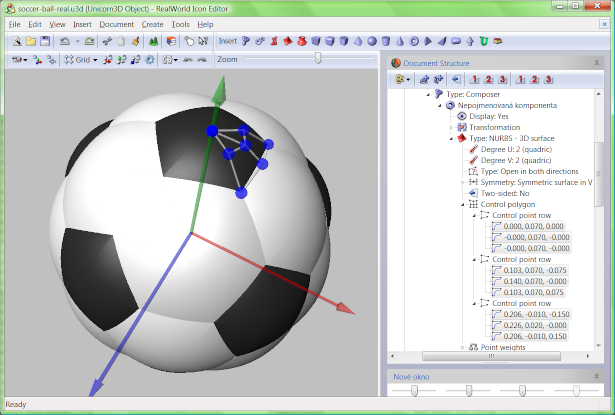
 Torus was added to the 3D model using 'Insert component' command. 3D view can be rotated using right mouse button and zoomed using mouse wheel.
| |  Modify torus matrial in the tree view and set the inner an outer radius using control points or overwrite values in tree view.
|
 To create the central part of a speaker, insert new component - a 'Surface of revolution'.
| |  Change the material color to the same color as in the previous step and drag the control points to adjust the surface shape.
|
 Select one of the control points in 3D view and the corresponding item will be highlighted in tree view. Click on the toolbar button named 'Insert knot...'.
| |  Set the color of material to 0.2, 0.2, 0.2 and move the control points to proper positions in 3D view or type the exact value in tree view.
|
 Locate the 'Degree' item in the tree view. Right click on it and select '2 (quadric)' from the pop-up menu.
| |  Insert three knots at positions 0.25, 0.5, and 0.75. In this case, the multiplicity will remain at 1 and therefore there will be no visible edges in the curve.
|
 Position the control points according to the screenshot and modify material color of this shape to 0.2, 0.2, 0.6.
| |  The position of the speaker edge is wrong and needs to be fixed. We will move it up by applying translation.
|
 There are many ways to configure camera. One of them is to rotate and zoom the 3D view and then clicking 'Camera from 3D view' button. Alternativelly, the camera properties may be entered manually in tree view.
| |  After the lights are added, some of their properties are controlled by control points in 3D view. Others are only configured from tree view.
|
 Adjust the image size to 512x512 to get better results, create an icon by clicking a toolbar button, and then OK twice.
| |  The icon was generated, the only thing left is to save it.
|
 This 3D model was created in RealWorld Icon Editor and used to make a BMW icon in the set of car manufacturers' logos.
| |  Reproducible results: 'Rendered Image' holds a snapshot of camera settings, lighting, rendering properties and image dimensions.
|
 All functionality usually found in a professional icon maker is there. And more: Tutorial on making a speaker icon.
| |  An icon is created from image by clicking one of the marked toolbar buttons.
|
 This model was made from two components ('3D' and 'text'). A rotation and translation is applied on the 'text' part.
| |  Preparing a scene with a model of 3D text for rendering. The blue dots represent multiple directional lights used to create a soft shadow.
|