Starting with version 2009.1, RealWorld Designer-based applications can be translated from within the application. This page contains information on how to create a translation or contribute to an existing one.
Important: Do NOT translate the application using automated translation services into languages you are not fluent in!
Enable Translator mode by checking the appropriate box.
Select language of your choice.
Click Download to find out whether someone has already translated part of the application to this language.
Click OK.
Step 2: Work with the application for a while
When translator mode is active the application gathers information about expressions that need to be translated. Just work with the application for a couple of minutes, do what you usually do with it.
Step 3: Translate for a while
Open the Application Options window again.
The box in the lower part of the Language tab now contains a list of strings that need to be translated.
Click on any item - it it displayed in the text box labeled Original string. Resize the window if needed.
Type translation of the string into the text box labeled Translated string.
Continue with another strings. (You can press Enter to go to the next string in the list.)
After you have translated some strings, click Upload button to send your translations to the server (and eventually download items translated by others).
What else you should know
It is a good idea to start translating from the top of the list. Expressions near the top are used most often by the application.
Try to make the translated string roughly the same length as the English string, the space might be limited.
It might be in rare cases necessary to add an end of line character to the translation. Since the Enter key serves to go to the next string in the list, press and hold the CTRL key while pressing Enter to go to next line.
Anonymous translators can only add translations for yet untranslated strings. Logged-in translators can also modify strings added by them or by anonymous translators.
Special characters
If you encounter character sequences like &, %i, %s, %f, \n or others, Do not remove them.
Important: %i (and others like %s, %f, %g, %x, %08x, etc.) are replaced at runtime with actual values. This can be used for example to display numerical error codes or to concatenate strings. Always keep the same % codes in the translated string in the same order as in the original string.
\n or \r indicate End-Of-Line. Use them in the translation as well.
The & character indicates that the next character is a keyboard accelerator. For example in &File, the F characters serves as an accelerator for the File menu (when you press ALT+F, the File menu opens). It also works in dialog windows to jump between controls.
If the source string has a & in it, you should put one in the translated string too. You can put it in front of any standard character, but it is not recommended to put in in front of numbers or characters that are not on the standard keyboard (for example it shall not be put in front of č in Czech, because the user cannot easily press ALT+Č).
Also, each item in a single menu should have different accelerator. For example &Save and Save &as... are in the same menu and therefore they have different accelerators - S and A.
The | characters are occasionally used as string separators. One string may contains multiple related sub-strings. Keep the same number of | characters in the translation.
I want support your product Translated to Arabic I wish to obtain admission to Arab user can deal with the program correctly and correct Also want to translate your software fully support me for your products and Arab users I hope accepting my invitation with the full support for your software please replay with agree or disagree, we don't take money
Sender MFM Dawdeh
Anonymouson January 30th 20140
You must correct word Undo in portuguese, the correct is Desfazer, not Fesfazer
Anonymouson November 28th 20190
رائع
Anonymouson June 26th 20200
😮 😎 😴 😉 😁 😞 WOW
OKAY IM IN THAILAND 😁 😊 GOOD
Anonymouson July 1st 20200
null
Anonymouson October 4th 20240
شكرا 😁 :-D 😁 :-D 😁
Anonymouson April 27th 20250
this is all so awesome, i love this finding, the perfect site c: (dont mind the rude people here) 😎 😁
Duploon October 6th 20250
For translation, is there a way you could add Toki Pona? I'd just enjoy translating the app into Toki Pona for fun :]

 Sign in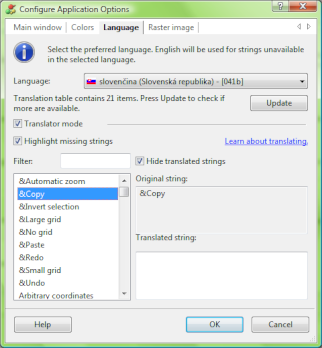
 Recent comments
 Anonymous
on July 5th 2013
0
Anonymous
on July 5th 2013
0
 reddit
 Facebook share